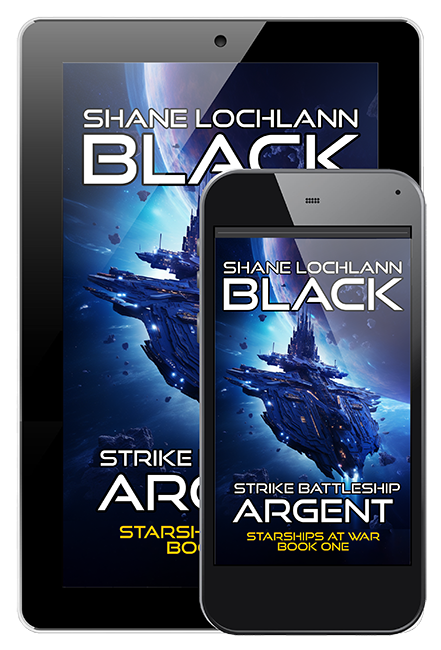
Strike Battleship Argent Ebook
Aboard the Alert Three gunship, Junior Lieutenant Maxwell Abee successfully ordered an evasive maneuver that rocketed T-Hawk Six into a diving roll. The rest of his five-man crew breathed a machine filtered sigh of relief as they silently thanked him for not listening to the steady stream of complaints about orders to keep their shock harnesses threaded and fastened.
Moments later a formation of lethal warhead-tipped missiles ripped through space directly through their previous course. Right behind them was the still-unidentified Kilo X-Ray contact.
“Target acquisition! We’re being lit up!” Flight Specialist Katsa shouted.
“Pivot on your bearings and bring our forward screens to double power!” Abee replied. The relatively tiny gunship turned to face the enemy cruiser’s starboard edge like a vicious little insect ready to take on a cat. “Take your best shot, you sonofa–!”
Red and white beams exploded from the emplacements on the cruiser’s upper hull. Each shot pounded and ripped against T-Hawk Six. Her overloaded battle screens glowed angrily. But, like an experienced prize fighter, the gunship took the punches, absorbed as much of the energy as she could, and struck back.
The Tarantula Hawk hunter-killer gunship was second only to the Paladin multi-role hull in its formidable array of combat abilities. Among the many things a T-Hawk could do was convert a limited amount of enemy weapons energy to capacitance potential, and then feed it back into its own short-range defenses. In other words, the more you shoot at a T-Hawk, the more ammunition you’re giving it to shoot back at you.
This, among other things, was one reason the little gunships were so damn annoying. They were built like little bricks of ablative armor and bristling with nasty weapons. Absent a truly overwhelming center-of-mass shot with a hypervelocity shipkiller missile, they were virtually impossible to disable completely much less destroy outright. T-Hawks were roughly three times the mass and volume of a fighter, but could bring as much as four times the equivalent firepower to bear.
T-Hawk Six lived up to its reputation moments after being staggered in space by the enemy cruiser’s short range energy weapons. The tiny gunship opened up with its brawler cannons and pounded away at the much larger vessel’s shields. The cruiser shuddered with the punishment, and an alarming number of its armor plates buckled under the first barrage. For a few moments the two ships traded punches like it was the 12th round of a mismatched and unsanctioned bout in a speakeasy basement.
What the enemy ship didn’t realize was T-Hawk Six was only one part of a three-ship alert group. Long before grappling with the gunship, enemy fire control had completely lost track of the two Yellowjacket fighters that had peeled off evading the cruiser’s missiles. With the Nemesis corvette blasting EM interference all over the sector, by the time their point defenses recovered, it was too late.
The rest of Alert Three came screaming in on the cruiser’s ventral Z-axis like diving peregrine falcons. The angry-looking little ships were no match for the cruiser in a toe-to-toe fight, but that wasn’t what made Yellowjackets threatening. These two second-generation fighters were armed with the most advanced torpedoes ever deployed aboard a Core ship of the line. Their technical designation was the “Mark Five Gravity-Activated Rail-launched Oxygen Compression Torpedo.” Jack pilots called them “Fives.” In keeping with the traditional playing card metaphor of the Yellowjacket fraternity, the saying went that “a pair of fives beats anything.”
The reason these particular weapons were so devastating was they took full advantage of the pressure differential and consequential energy potential between the vacuum of space and the pressurized interior of a starship. Any ship with a combustible element in its atmosphere mix was vulnerable to a “Five” torpedo. Given the traditional realities and requirements of biology, there were few species with ship atmospheres without at least one energetic element, and that’s all the torpedo’s warhead needed to unleash a fiery vengeance on everything exposed to that atmosphere.
Twin “fox fives” separated from their launchers and locked targeting frequencies with identification data pulled from all five Core ships in the vicinity. In a space of a few nanoseconds, the onboard logic systems confirmed to six decimal places of certainty the big enemy cruiser in front of them was the correct target. At that moment, acquisition alarms were likely sounding a hellish din on the ship’s bridge, but at this range, such a sound was only useful to warn crew members their world was about to literally turn upside down.
Both torpedo’s went hypermach in the same instant and slammed into the ventral hull of the enemy cruiser just forward of her main engine cowlings. The dense points of the torpedos punctured the coated metal frame and buckled the ship’s support structure in several places. Twin deck-shattering explosions ripped twisted chunks of scorched metal out of the vessel’s interior and covered everything visible with a light-absorbing grayish paint-like substance. From outside the ship it looked like someone had popped a huge black bubblegum bubble all over the inside and outside of the ship. The pause lasted for about four seconds. Then the ship began to bleed atmosphere, and what started out as black goo very rapidly turned into what appeared to be molten white-hot glass.
Plasma began to stream from the enemy cruiser’s aft section as its energy dampeners and shields fought mightily to control the unusual chemical and magnetic reactions taking place both inside and outside its primary hull. Had the proper equipment been present, it would have registered the perfect conditions forming in the breach between the inner atmosphere and the hard vacuum of space. At the point where the hull had been punctured, a highly compressed combination of a temperature inversion and a bubble of pure oxygen had formed, with all the other trace elements drained out of the atmosphere and into the chemicals left behind by the armor-piercing explosions.
The molecular clock ticked until finally the ionization reached a tipping point and a small bolt of lightning arced across the enemy ship’s deck, igniting a dangerously compressed oxygen hypernova. Almost exactly five seconds after impact, twin explosions lit up space for two million miles.
Staggered, off course and bleeding from nearly a dozen hull breaches, the enemy cruiser somehow miraculously righted itself and bore down on DSS Argent. T-Hawk Six pursued, engaging the larger vessel’s aft point defense in a running firefight towards Captain Hunter’s command.
BackContents Continue